
Structure–Semantics Adjunction for Tractable FunctorsNatural bijection of the adjunctionFrom
Structure–Semantics Adjunction for Tractable Functors
Consider the full subcategory of
Denote this category by
Let
Hence we obtain a functor
This functor admits a left adjoint, called Struct. Concretely, given a tractable functor
objects are the natural numbers
morphisms
Let 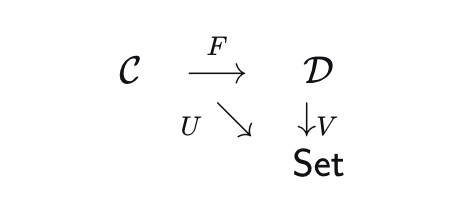
Now we define
On objects:
On morphisms: take
Because
Natural bijection of the adjunction
We need to establish a natural isomorphism
or equivalently
The left‑hand side consists of functors
commute.
The right‑hand side consists of product‑preserving functors
From
Given
Hence we define
For a morphism
and
Because each
From
Given a theory morphism
On objects:
On morphisms: for
Since
For a morphism
Naturality of
Mutual inverses and naturality
The two constructions are mutually inverse: starting from
Indeed, this adjunction tells us that given a model of an algebraic theory, we can reconstruct the theory via its forgetful functor.
If
The counit and its isomorphism property – with concrete examples
We now give a detailed, concrete account of the counit of the structure–semantics adjunction, showing why it is an isomorphism. We work entirely within the framework of Lawvere theories and tractable functors, but illustrate each step with familiar algebraic theories such as groups.
Extracting the counit
Take
On the left side of
The inverse of
which, after reversing the direction, corresponds to an ordinary theory morphism
What
On objects:
On morphisms: For
(Recall that
Thus
A concrete example: the theory of groups
Let
The theory extracted from
The theory
A natural transformation
Thus
The evaluation map in the group case.
The theory morphism
the abstract multiplication
the abstract inverse
the abstract unit
Injectivity: if two abstract terms behave identically on all groups, they must be the same term (test on free groups).
Surjectivity: any natural family
Hence
Why this shows the counit is an isomorphism
By definition of the adjunction, the counit
Thus:
Consequences: full faithfulness and reflective subcategory
Since the counit is an isomorphism, the right adjoint
Its essential image consists exactly of those tractable functors that are (up to isomorphism) of the form
A fully faithful right adjoint has its image as a reflective subcategory; therefore the image of
embeds any concrete category
Summary
The evaluation map
Functorial semantics tells us this map is always bijective, so
via the counit. Consequently, the theory is completely encoded in its category of models together with the forgetful functor, and the structure–semantics adjunction gives a precise duality between syntax (the theory) and semantics (the concrete category of models).


No comments:
Post a Comment