Once you have proved the Cayley–Hamilton theorem over algebraically closed fields (by AG),you know it holds for integral domains, and in particular for the integral domain
This ring is the representing object for the functor , with universal element the generic matrix . For any commutative ring , a matrix in corresponds to a ring homomorphism .
We already know that ; therefore
In abstract terms, the assignment is actually a natural transformation, and it is the zero transformation. Consider the following diagram; it is easy to verify that it commutes:
Yoneda’s lemma tells us that
Thus is completely determined by its action on the universal element. That is, we only need to consider...
Proof
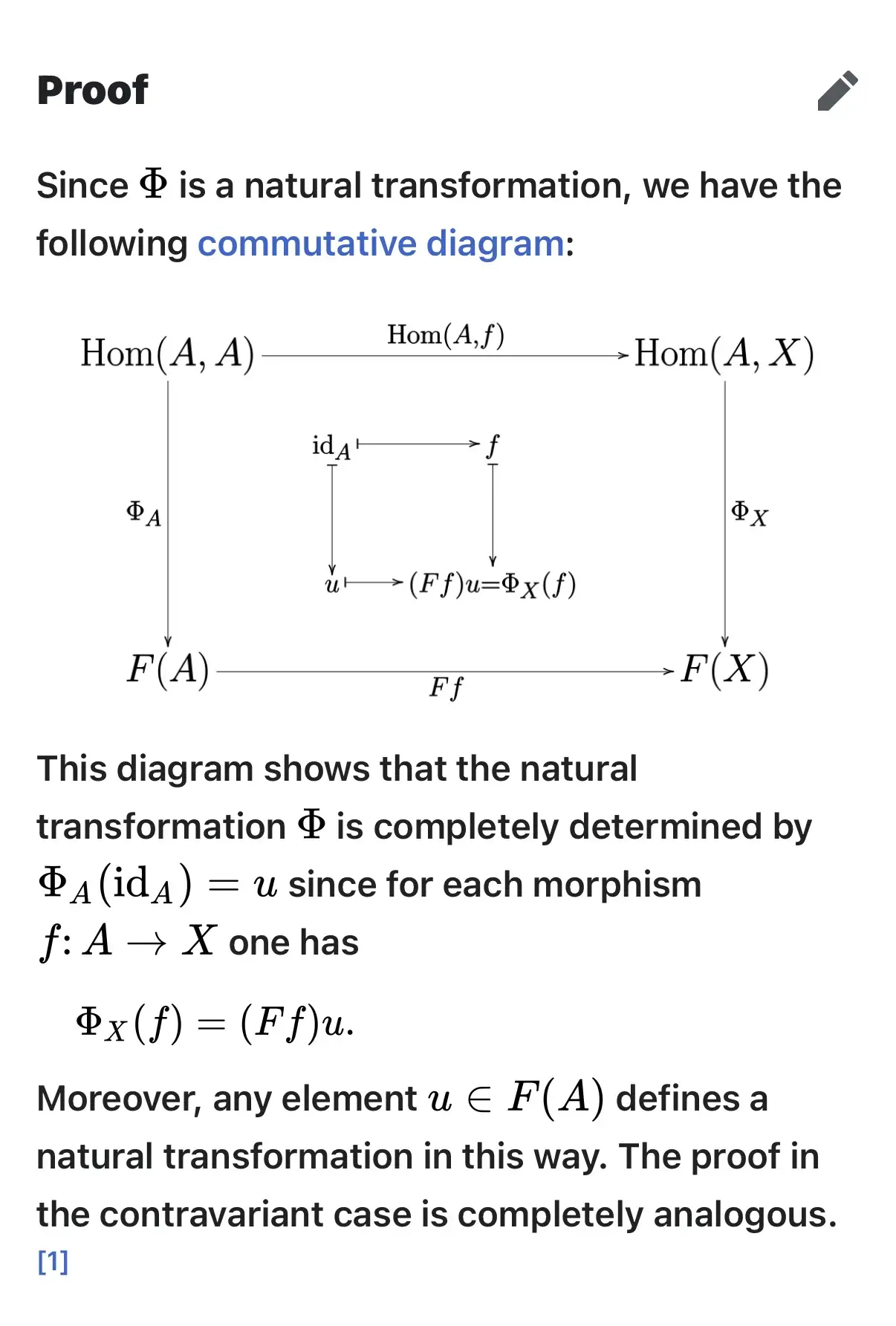
Since is a natural transformation, we have the following commutative diagram:
This diagram shows that the natural transformation is completely determined by since for each morphism one has...
Here is the zero natural transformation, sending every matrix to the zero matrix.



No comments:
Post a Comment