
Topology as a Monad on the Power Set
We can view topological spaces and continuous functions through the lens of closure operators and monads.
From topology to a closure monad
Recall that a topology on a set
Consider the power set
The closure operator defines a monad
The unit
The multiplication
Direct image functor
A function
Lax monad morphism
Let
A functor
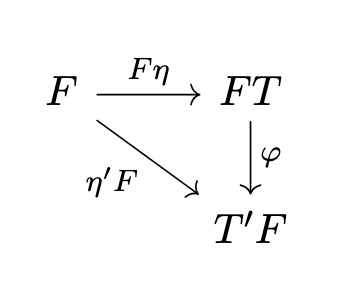
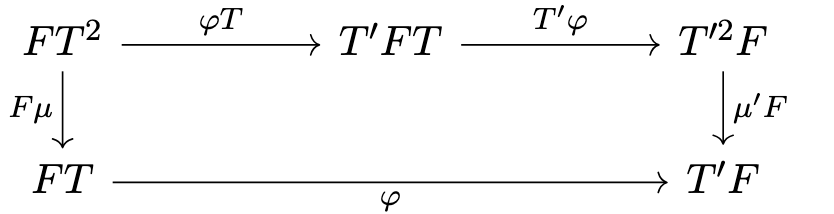
such that the following diagrams commute:
Unit coherence:
Multiplication coherence:
Continuity as a lax monad morphism
We claim:
is continuous iff is a lax monad morphism between the closure monads.
Indeed, the natural transformation required is an inclusion:
This inequality is precisely the usual characterisation of continuity in terms of closures. The remaining coherence conditions (unit and multiplication) automatically hold because we are in a poset category (all diagrams commute trivially) and the closure operator is idempotent.
Thus, the monad framework gives a very compact definition: a continuous map is exactly a functor between power sets that laxly preserves the closure monad structure.


No comments:
Post a Comment