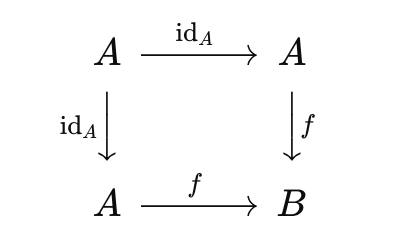
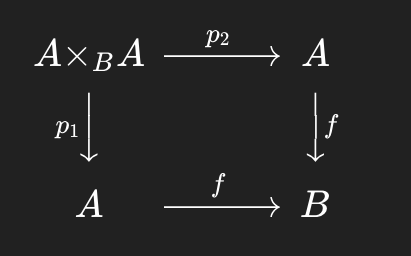
So the syntax of a poset should be given by a finite limit sketch.
Let us begin with the finite limit sketch of monomorphism.
In a category with finite limits, is mono iff the following diagram is a pullback.
Hence we can define the sketch of monomorphism, denoted by .
By duality we can define the sketch of epimorphism, denoted by .
Here is a simple application.
In all concrete categories with a free-forgetful adjunction, such as
all monomorphisms are injective functions, but epimorphisms are not necessarily surjective.
Here is the reason: the forgetful functor, as a right adjoint, preserves limits. Hence it maps a model of a finite limit sketch to another model. But in general, it does not need to preserve colimits.
An interesting example is . The forgetful functor admits both a left and a right adjoint, i.e. the discrete topology and the trivial topology. Hence the forgetful functor preserves both limits and colimits. However, for , the forgetful functor does not admit a right adjoint anymore. Also, epimorphisms should not be surjective there either.
For example, a dense inclusion is epi but not surjective. Here is the reason: click here
A binary relation is a monomorphism .
Hence we can define the sketch of a relation, denoted by .
Now we would like to describe the pre-order relation .
What is reflexivity?
In other words, is a subobject of .
What is transitivity? Consider ; it represents something like .
Let be the two projections, and also let .
Transitivity claims that there exists a map such that
To express transitivity, write the relation as a map , and let and . Then form the pullback
along and , so that a point of represents a composable pair and .
Let the two projections be . Transitivity is expressed by requiring a morphism such that
Equivalently,
This means that from a composable pair we obtain a relation .
Hence we get the sketch of a pre-order. Let us denote it by .
To express antisymmetry, consider the opposite relation , obtained by composing with the symmetry map .
Then form the pullback
which represents pairs such that both and hold. Antisymmetry means that such a pair must lie on the diagonal. In other words, the map factors through the diagonal , i.e. is a subobject of .
Equivalently, there is a morphism such that
This expresses precisely that whenever and , one must have .
Hence we get the sketch of a poset, denoted by .
To express symmetry, let be the symmetry map exchanging the two factors. Then the opposite relation is the composite
Symmetry means that whenever , we also have . Equivalently, the opposite relation factors through itself. In other words, there is a morphism such that
This says that every relation in is sent to the reversed relation , so the relation is symmetric.
Hence we get the sketch of an equivalence relation, denoted by .
We could consider the sketch of a kernel pair as well.
In general, let be a locally small category with finite limits, and let be a model of a finite limit sketch .
Then
is a model of in , since the Yoneda embedding preserves limits.
Hence, if is an internal poset, then is a poset-valued functor.