How do you prove that the intersection of two normal subgroups — or two ideals — is again normal? The naive approach is to verify the condition directly: take , , and check that . It works, but it feels like brute force. You are essentially running the same verification twice, once for and once for , with no insight into why the result is true. The real reason is simpler: normal subgroups and ideals are kernels, and kernels are pullbacks of the zero object...
Let be a category with finite limits. Consider a morphism
We can induce a pair of adjoint functors
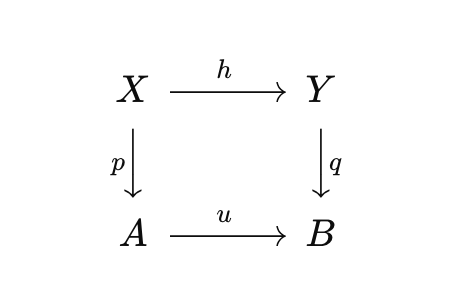
Here , while is defined via the pullback square. That is, .
Let us check the adjointness:
This is just the universal property of the pullback. Hence preserves limits:
Corollary. Let , and let be two subobjects of . Then
where is just .
If has a zero object, then we have . This follows from the fact that is just the pullback of along .