This blog is a polish of:
G. Zolotarev, Nouvelle démonstration de la loi de réciprocité de Legendre, Nouv. Ann. Math (2), 11 (1872), 354-362
https://marco-yuze-zheng.blogspot.com/2024/03/legendre-symbol-exact-sequence-point-of.html
We know that from Cayley's theorem, we have a injective homomorphism .
Lemma 1. Let be an even number, then there is an unique surjetive group homomorphism .
Proof. It follows from the ideal is the only possible kernel.
Notice that , we have following diagram commute.
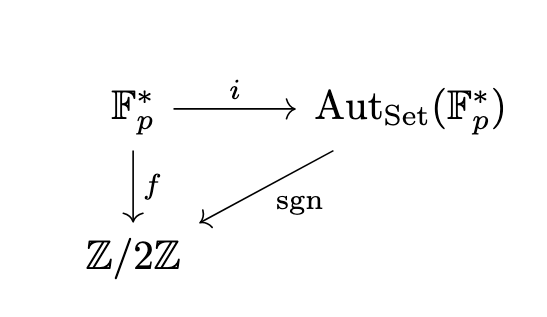
Thus we have .
The Law of Quadratic Reciprocity
Now consider and
Now define the permutation by
The key point is
Hence
Also,
Since actually is acting on , and equal to composition of and .
But . But hence .
Hence , similarly, .
Hence
Now let us compute , i.e. we need to count the number of the inversions.
Hence , and this force that is the condition of inversions.
Hence the number of inversions are , this shows that


