Blog Archive

Friday, October 4, 2024

Introduction to tensor (5): Tensor product of R-alg(coproduct), polynomial functor and its adjoint

Polynomial functor and its adjoint

Polynomial functor and its adjoint

Let R be a commutative ring and X be a set,

(1)R[]:S→R[S]

gives us a functor from category of set to category of R−​algebra.

The right adjoint of R[] exists, indeed, it is the forgetful functor F from R−Alg→Set.

(2)HomR−Alg(R[S],L)≅HomSet(S,F(L))

Proof.

Let f:R[S]→L be a R−Alg homomorphism, then f is totally determined by the value at f(s),∀s∈S​.

Hence we get an injective from HomR−Alg(R[S],L)→HomSet(S,F(L)). To see it is a surjectiion, notice that every function g:S→F(L) gives us a unique R−algebra homomorphism, i.e. evaluation map. The naturalness leaves to readers. ◻

Tensor product of R-Alg

Let L,K be two R−algebra, the tensor product of L,K is defined as L⊗RK.

The multiplication in L⊗RK is defined as:

(3)(l⊗k)(l′⊗k′)=ll′⊗kk′

The identity is 1L⊗1K.

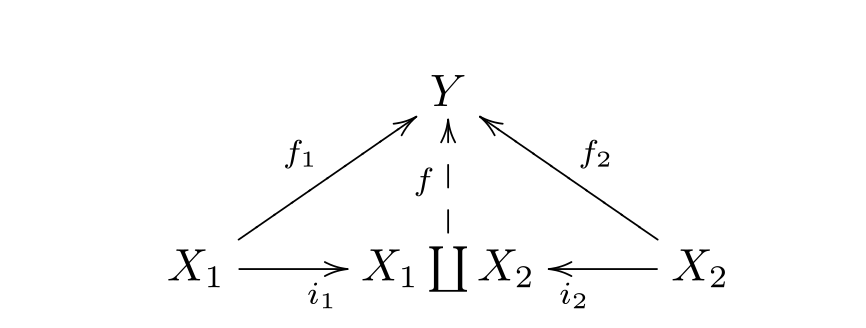
Proposition. Tensor product of two R-algebras is coproduct in category of R−algebra.

image-20241004190112134

Proof.

Let i1:L→L⊗RK,l⟼l⊗1K, similarly for i2. For any fj:Xj→Y, we have fj=f∘ij, i.e.

(4)f(l⊗1K)=f1(l),f(1L⊗k)=f2(k)

Extend it to a ring homomorphism, it uniquely define the f​

(5)f:L⊗RK→Y,f(l⊗k)=f((l⊗1K)(1L⊗k))=f1(l)f2(k)
(6)f(l⊗k+l′⊗k′)=f(l⊗k)+f(l′⊗k′)

Corollary

Since R[] is a left adjoint functor, hence it preserve colimit:

(7)R[X∐Y]≅R[X]⊗RR[Y]

The isomorphism is given by

(8)h(xi⊗yj)=xiyj

Remark. Let f:L→Y,g:K→Y be two R-algebra homomorphism, then the image of the universal map

(9)L⊗RK→Y,l⊗k→f(l)g(k)

is generated by f(L),g(K)​.

Here f(L),g(K) is two subalgebra of Y, and the subalgebra f(L)g(K) could be viewed as a quotient algebra of L⊗RK.

Proposition. (A/I)⊗R(B/J)≅A⊗RB/(A⊗RJ+I⊗RB)​.

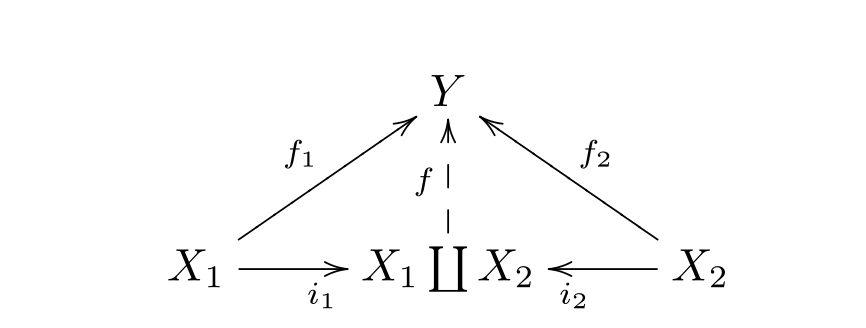
Proof. Let us use the universal property of coproduct.

image-20241004190112134

Let i1:a+I⟼a⊗1B+(A⊗RJ+I⊗RB),i2:b+J⟼1A⊗b+(A⊗RJ+I⊗RB)

For any f1:A/I→Y,f2:B/J→Y, and define f∘i1=f1,f∘i2=f2, i.e. f∘i1(a+I)=f1(a⊗1B+(A⊗RJ+I⊗RB)),f∘i2(1A⊗b+(A⊗RJ+I⊗RB))=f2(b+J).

Hence f is defined as

(10)f(a⊗b+(A⊗RJ+I⊗RB))=f1(a⊗1B+(A⊗RJ+I⊗RB))f2(1A⊗b+(A⊗RJ+I⊗RB))

It is well defined and unique, hence

(11)A⊗RB/(A⊗RJ+I⊗RB)

is coproduct of (A/I),(B/J), hence it is isomorphic to (A/I)⊗R(B/J). ◻

Corollary.

Let p1,...,pn∈R[X1,...,Xn],q1,....,qm∈R[Y1,...,Yn], then

(12)R[X1...Xn]/(p1,...,pn)⊗RR[Y1,...,Ym]/(q1,...,qm)≅R[X1,...,Xn,Y1,...,Ym]/(p1,...,pn,q1,...,qm)

The adjoint between extension of scalars via tensor product and restriction of scalars

Let f:A→B be an R−alg, then we can view B as a A−module via φ(a)b.

For an A−module M, we could give an B−module for M by considering B⊗AM via b⋅(b′⊗m)=bb′⊗m

It gives us a functor

(13)f!:Mod(A)→Mod(B)
(14)f!M=B⊗AM,for an A−linear mapφ:M→N,f!(φ)(b⊗m)=b⊗φ(m)

Also, for an B−module M, we can define an A−module structure on M via f(a)m.

This gives us a functor

(15)f∗:Mod(B)→Mod(A)

Propostion. f! is the left adjoint of f∗.

Proof.

We need to prove:

(16)HomMod(B)(f!M,N)≅HomMod(A)(M,f∗N)

For convenience, we use A,B for Mod(A),Mod(B).

(17)Φ:HomB(B⊗AM,N)→HomA(M,f∗N),

By

(18)Φ(ϕ)(m)=ϕ(1B⊗m)

This is an A−linear map since

(19)Φ(ϕ)(am)=ϕ(1B⊗am)=ϕ(f(a)1B⊗m)=f(a)ϕ(1B⊗m)=aΦ(ϕ)(m)
(20)Ψ:HomA(M,f∗N)→HomB(B⊗AM,N)

By

(21)Ψ(φ)(b⊗m)=bφ(m)

To see it is well-defined, we need to check that

(22)Ψ(φ)(ba⊗m)=Ψ(φ)(b⊗am)

Since Ψ(φ)(ba⊗m)=baφ(m)=bφ(am)=Ψ(φ)(b⊗am), hence it is well defined.

To see it is B−linear,

(23)Ψ(φ)(b′(b⊗m))=Ψ(φ)(b′b⊗m)=b′bφ(m)=b′Ψ(φ)(b⊗m)

and they are pair of inverse since

(24)Ψ∘Φ(ϕ)(m)=Ψ(ϕ(1B⊗m))=ϕ(m)

and

(25)Φ∘Ψ(φ)(b⊗m)=Φ(bφ(m))=bΦ(φ(m))=bφ(1B⊗m)=φ(b⊗m)

The naturalness leave to readers ◻

No comments:

Post a Comment

Popular Posts