
Proposition. is the initial object of .
Proof. We need to show that for any ring , there exists a unique ring homomorphism .
The unique arrow is given by , hence .
Easy to see that is a ring homomorphism. To see it is the only ring homomorphism, notice that a ring homomorphism has to map to .
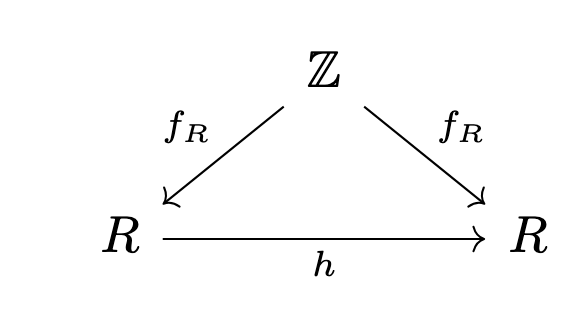
Hence we could view as .(No worries if you have no idea about )
The universal property tells us that any ring homomorphism has to fix every since the diagram is commutes.
Application. Fermat's little theorem
Let , hence is the quotient map. Notice that , hence for any ring endomorphism of , we have . Hence the only ring endmorphism of is .
Notice that the Frobenius endomorphism is a ring endomorphism of , hence it has to be .
Hence we have . i.e.
Definition.
The characteristic of is defined by the kernel of . If , then the characteristic of , is .
But it is too boring and not useful enough. Let us define the characteristic functor, .
For a ring with , . For with , .
Easy to see that this is a functor. It tells us that if is not a factor of , then there is no ring homomorphism from to .


No comments:
Post a Comment